spaceship aprroaching planet x at a speed what is the speed of the probe relatove to planetx
If Planet Ix exists, why has no one seen information technology?
(Image credit:
ESA/Hubble, Yard. Kornmesser
)
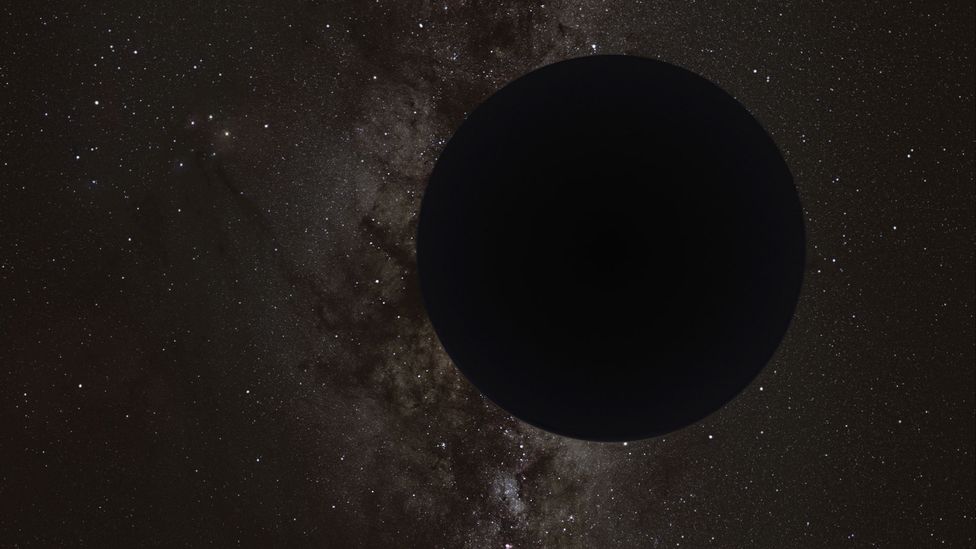
Strange things are happening at the outer edges of our solar system. An object up to 10 times the mass of Globe is pulling others towards it. Is it a planet, or something else?
A
As we head towards the end of some other extraordinary year, BBC Time to come is taking a look back at some of our favourite stories for our "Best of 2021" collection. Discover more of our picks here.
Percival Lowell was a man of many errors.
The 19th-Century travel writer and businessman – fabulously wealthy, perennially moustachioed, and oft found in crisp three-slice suits – had read a book on Mars, and on this basis, decided to go an astronomer. Over the coming decades, he made a number of wild claims.
Starting time up, he was convinced of the being of Martians, and thought he had institute them (he hadn't). Others had documented foreign lines traversing the planet, and Lowell suggested that these were canals, built as the concluding attempt of a dying civilisation to tap water from the polar ice caps. He used his fortune to build an entire observatory, just to become a improve expect. It turned out they were an optical illusion, created by the mountains and craters on Mars when viewed through low quality telescopes.
Lowell also believed that the planet Venus had spokes – seen in his notes as spidery lines emanating from its heart (it doesn't). Though his assistants tried to find them, it seemed that only he could see this unexpected detail. It's now assumed that they were shadows bandage from the irises in his own eyes, as he looked through his telescope.
Just almost of all, Lowell was determined to find the ninth planet in our solar system – a hypothetical "planet X", which at the fourth dimension was thought to exist responsible for the rogue orbits of the furthest-known planets from the Sun, the absurd-blueish ice giants Uranus and Neptune. Though he never prepare eyes on this phantom behemoth, the quest consumed the last decade of his life – and after several nervous breakdowns, he died at the age of 61.
Little did he know, the search would nonetheless be going – with a few tweaks – in 2021.
A fake trail
Undeterred by his own mortality, Lowell left a million dollars to the cause of finding planet Ten in his will. So, after a cursory interlude involving a legal battle with his widow, Constance Lowell, his observatory kept looking.
Just 14 years later, on 18 February 1930, a young astronomer was looking at two photos of star-studded skies, when he noticed a speck amongst them. It was a tiny world. He had found Pluto – for a while considered the elusive planet X.
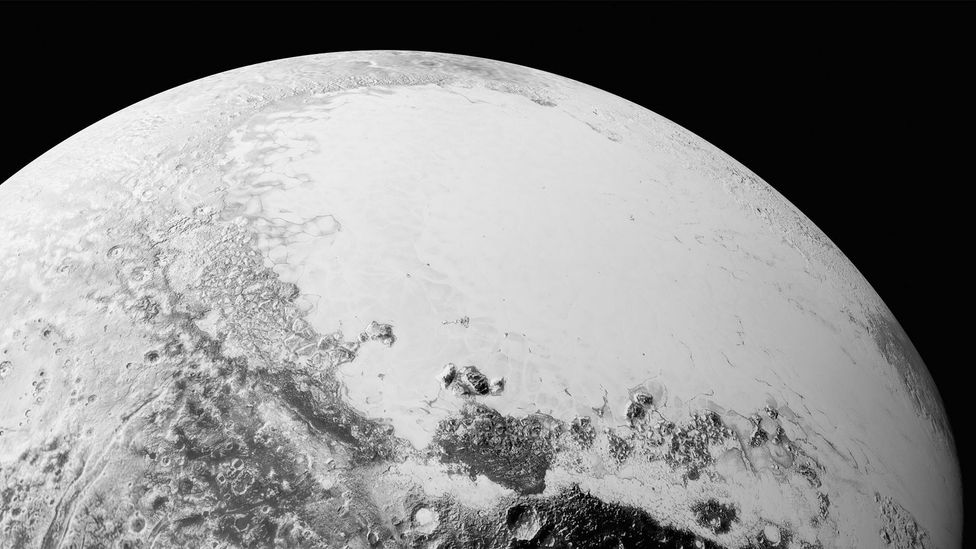
Pluto was demoted to a dwarf planet in 2006, leaving an opening for a new ninth planet (Credit: NASA/ Johns Hopkins University /Southwest Inquiry Institute)
Alas, it was not to exist. Soon scientists realised that this could non exist what Lowell was looking for – it was not well-nigh large enough to pull Neptune and Uranus abroad from their rightful positions. Pluto was just an accidental interloper, which happened to be in the area.
The final accident to planet X came in 1989, when the Voyager 2 spacecraft swept by Neptune and revealed that it'due south fractionally lighter than anyone had originally thought. With this in mind, eventually a Nasa scientist calculated that the orbits of the outer planets had made sense all forth. Lowell had instigated a search that had had never been needed.
Only just as the concept of a hidden planet was killed off, the background was laid for its resurrection.
You might likewise similar:
- Voyager: Within the world's greatest space mission
- Should astronauts abandon the infinite station?
- Spaceplanes: The return of the reusable spacecraft?
In 1992, two astronomers who had "doggedly scanned the heavens in search of dim objects across Neptune" for years, co-ordinate to Nasa, discovered the Kuiper Belt. This cosmic donut of frozen objects, extending just beyond the orbit of Neptune, is one of the largest features in the solar system. Information technology's and so vast, it'southward thought to contain hundreds of thousands of objects larger than 100km (62 miles) beyond, as well equally upwards to a trillion comets.
Soon scientists realised that Pluto was unlikely to be the only large object in the outer reaches of the solar system – and began to question whether it was actually a planet at all. Then they found "Sedna" (around 40% of the size of Pluto), "Quaoar" (around half the size of Pluto), and "Eris" (almost the same size equally Pluto). It became articulate that astronomers needed a new definition.
In 2006, the International Astronomical Union voted to demote Pluto'due south status to a "dwarf planet", along with the newcomers. Mike Brown, a professor of planetary astronomy at the California Institute of Technology – Caltech – who led the team that identified Eris, is self-styled as the "man who killed Pluto" to this day. The ninth planet was no more.
A ghostly signature
At the same time, the discovery of these objects uncovered a major new atomic number 82 in the search for a hidden planet.
It turns out that Sedna is not moving in the style everyone expected – tracing elliptical rings around the Sunday, from within the Kuiper Chugalug. Instead, this dwarf planet takes a bizarre and unexpected path, swinging from but 76 Earth-Sun distances (roughly eleven billion k/7 billion miles) from the eye of our solar arrangement to more than than 900 (roughly 135 billion km/84 billion miles). Its orbit is and so meandering, information technology takes eleven,000 years to complete – the final time Sedna was at its current position, humans had only simply invented farming.

Percival Lowell established his observatory in Flagstaff, Arizona to look for intelligent life on Mars. Somewhen information technology was used to find Pluto (Credit: Alamy)
Information technology'due south equally though something is tugging at Sedna and dragging it abroad.
Enter a hypothetical new addition to our solar system – but not as it was idea of before. In 2016, the aforementioned Mike Brown who had slain Pluto, together with his colleague Konstantin Batygin – also a professor of planetary scientific discipline at Caltech – co-authored a newspaper proposing a massive planet, between five and 10 times the size of Earth.
Their thought came from the ascertainment that Sedna was not the merely object out of identify. Information technology was joined by half-dozen others, and all of them are existence pulled in the same management. There are also other clues, such as the fact that each is tilted on its axis in exactly the same direction. The pair calculated that the probability of all vi objects being pulled in the exact aforementioned direction, with the aforementioned tilt by chance was only 0.007%.
"We thought 'this is quite interesting – how can this be?'" says Batygin. "It was quite remarkable because such a clustering, if left alone for a sufficiently long menses of time, would disperse, simply due to interaction with the gravity of the planets."
Instead, they proposed that Planet Nine had left its ghostly imprint in the outer reaches of our solar organisation, distorting the orbits of the objects around it with its gravitational pull. Several years on, and the number of objects that fit the eccentric orbital design and tilt has continued to increment, "We at present take around 19 overall," says Batygin.
Though no one has yet seen the hypothetical planet, it's possible to infer a surprising amount about it. Every bit with the other objects beyond the Kuiper Belt, the orbit of the new Planet Nine would be and then distorted that its uttermost reach is expected to exist twice equally far abroad equally its nearest – effectually 600 times the distance from the Dominicus to Earth (90 billion km/56 billion miles), vs 300 (45 billion km/28 billion miles). Scientists have besides hazarded a guess at its aesthetic – icy, with a solid cadre, like Uranus or Neptune.
And then there'south the slippery question of where Planet Nine might have come from in the first identify. So far, there are three primary ideas. Ane is that it formed where it currently hides, which Batygin dismisses every bit relatively unlikely because this would crave the early on solar system to take stretched out as far every bit its distant refuge.
There's also the intriguing suggestion that the ninth planet is really an alien imposter, an object that was stolen from another star long ago when the Sunday was nevertheless in the stellar cluster in which it was born. "The trouble with such a story is that you're just equally likely to then lose the planet upon the next encounter," says Batygin. "And then, statistically, that model runs into problem."
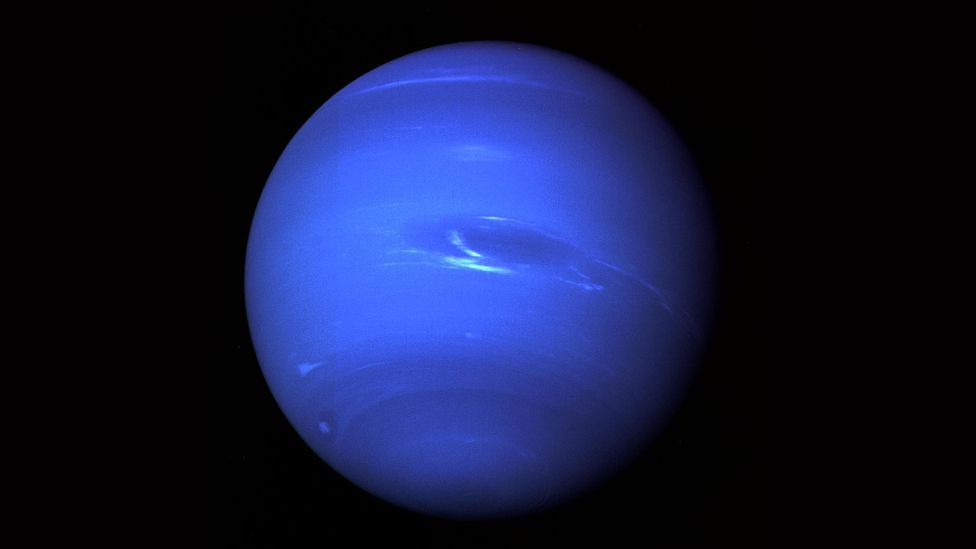
Neptune is currently the well-nigh distant known planet in our solar system, but there might exist another lurking across the Kuiper Belt (Credit: Nasa/JPL)
Then there's Batygin's personal favourite, which he admits is also "not a complete slam dunk". In this scenario, the planet formed much closer to the Sun, at a fourth dimension when the solar organization was in its early on stages and the planets were just beginning to coalesce out of the surrounding gas and dust. "Information technology kind of hung effectually the giant planet germination region, before being scattered out by Jupiter or Saturn, and subsequently had its orbit modified by passing stars," he says.
An obscure hiding identify
Of form, all this begs an obvious question – if Planet Nine is really there, why has no one seen it?
"I didn't have a particularly strong appreciation for just how difficult would be to observe Planet Nine until I started looking together with Mike using telescopes," says Batygin. "The reason it'due south such a tough search is because well-nigh astronomical surveys are not looking for a unmarried thing."
For example, astronomers would normally be looking for a class of objects, such as a item kind of planet. Even if they're rare, if y'all survey a wide enough expanse of infinite, you're likely to find something. But hunting downwards a specific object such as Planet 9 is a whole different exercise. "There's just ane tiny portion of the sky that has it," says Batygin, who explains that another cistron is the slightly more prosaic challenge of booking time slots to utilize the right kind of telescope.
"Actually, at the moment the only game in town for finding Planet 9 is the Subaru Telescope," says Batygin. This 8.2m behemoth – located at the summit of a dormant volcano, Maunakea, in Hawaii – is capable of capturing even the weak light of distant celestial objects. This is ideal, because the shadowy planet would be so far away, information technology's unlikely to be reflecting much light from the Dominicus.
"We have only one car that we can use, and we get maybe three nights on it a twelvemonth," says Batygin, who was fresh from a three-nighttime run on the telescope the previous calendar week. "The skillful news is that the Vera Rubin telescope is coming online within the adjacent couple of years, and they are going to probably find information technology." This next-generation telescope, currently under structure in Republic of chile, will be scanning the sky systematically – photographing the entire available view – every few nights, to survey its contents.
An intriguing alternative
However, there is i almost outrageously peculiar scenario in which the planet will never be found this way – information technology might not be a planet after all, but a black hole.
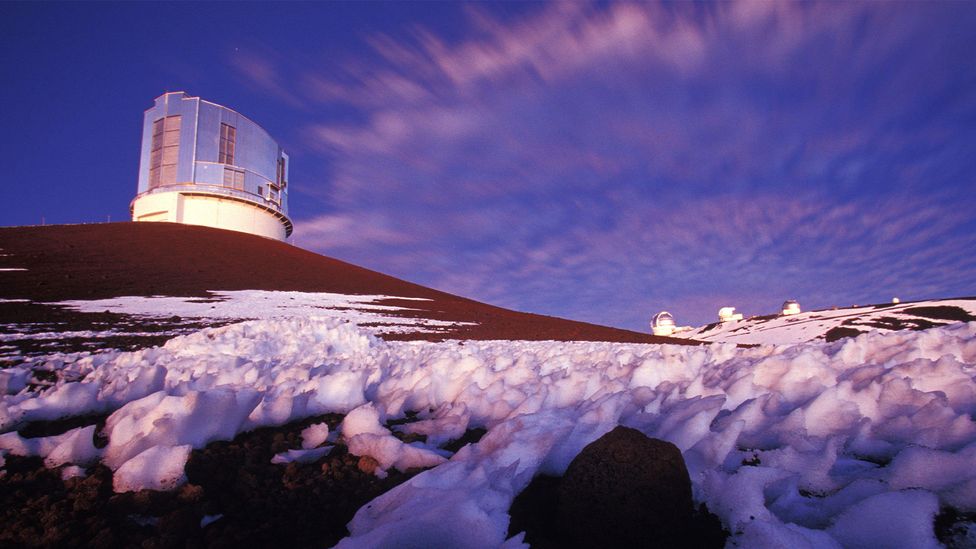
The Subaru telescope in Hawaii has already spotted the most distant known object in our solar organisation, nicknamed "Farfarout", during a search for Planet 9 (Credit: Alamy)
"All of the evidence for there being an object is gravitational," says James Unwin, professor of physics at the University of Illinois, Chicago, who first suggested the idea, along with Jakub Scholtz, a postdoctoral researcher from the University of Turin. While nosotros're nearly familiar with the idea that planets exert a powerful gravitational pull, "there are other things that can generate it, which are more exotic", says Unwin.
Some plausible replacements for planet nine include a small ball of ultra-concentrated dark matter, or a primordial black hole. As black holes are amidst the most dumbo objects in the Universe, Unwin explains that it's entirely possible the latter could be warping the orbits of distant objects in the outer solar system.
The black holes we're most familiar with tend to include "stellar" black holes, which have a mass that'south at least 3 times that of our own Sun, and "supermassive" black holes, which are millions or billions of times our Lord's day's mass, While the erstwhile are built-in out of dying stars collapsing in on themselves, the latter are more mysterious – perhaps kickoff as colossal stars which implode, and then gradually accumulate more and more than mass by devouring everything in their environment, including other black holes.
Primordial black holes are different. They take never been observed, only are thought to originate in the hot energy-and-matter brume that formed in the first second of the Large Bang. In this uneven environment, some parts of the Universe may have become and then dense, they were compressed into tiny pockets with the mass of planets.
Unwin points out that there is null probability of the black hole being formed from a star, since they keep their stiff gravitational pull – information technology's but concentrated. Fifty-fifty the smallest stellar blackholes accept masses three times that of our Sunday, so it would be like having at least iii extra Suns pulling at the planets in our solar system. In short, we would definitely take noticed.
All the same, Unwin and Scholtz say information technology could be a primordial black hole, since these are idea to be essentially smaller. "Because these things are born during the early on stages of the Universe, the dumbo regions they formed from could take been particularly small," says Scholtz. "As a result, the mass contained in this black hole that eventually is formed out of it can be much, much less than a star – they even tin be just a couple of pounds, similar a chunk of rock." This is more in line with the predicted mass of Planet 9, which is thought to exist equivalent to upwards to ten Earths.
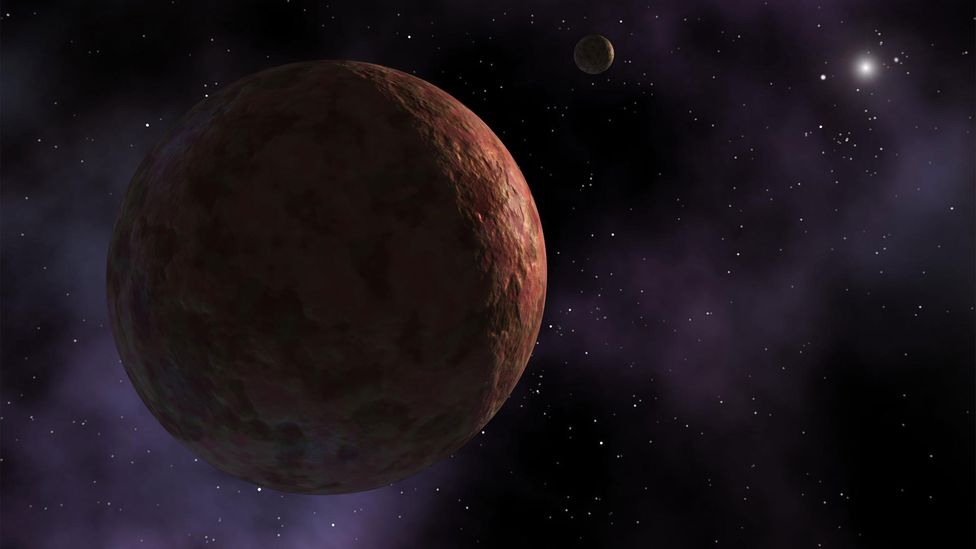
The dwarf planet Sedna has an unconventional orbit which might exist explained by the gravitational pull of a massive undiscovered planet (Credit: Nasa/ JPL-Caltech)
What would it look similar? Should we exist worried? And could this exist even more exciting than discovering a planet?
First, even primordial black holes are dense enough that no light can escape. They are the truest form of black. This means that this one would non testify upward on any kind of telescope that currently exists. If y'all were to look directly at it, the only clue to its presence would be a blank void – a tiny gap in the coating of stars in the nighttime sky.
Which brings us to the real snag. While the mass of this black hole would exist the aforementioned every bit that of the proposed Planet Nine – up to 10 times Globe's – it would be condensed into a volume roughly the size of an orange. To find it would require some ingenuity.
Then far, suggestions include looking for the gamma rays that are emitted by objects as they fall into black holes, or releasing a constellation of hundreds of tiny spacecraft, which might – if we're lucky – pass shut enough then that they'd be pulled towards information technology always-so-fractionally, and advance by a detectable amount.
Since the mysterious gravitational pull is emanating from the farthest reaches of our solar system, the probes would have to be sent via an Earthbound laser array, which could propel them to 20% of the speed of low-cal. If they travelled any slower, they might take hundreds of years to arrive – an experiment that would, naturally, stretch well beyond a human lifetime.
Every bit it happens, these futuristic spacecraft are already being developed for another ambitious mission, the Breakthrough Starshot project, which aims to send them to the Blastoff Centauri star arrangement, 4.37 light-years away.
If we were to discover a lurking black pigsty, rather than a frigid planet, Unwin says in that location would be no need to panic. "There's a supermassive black hole in the centre of our galaxy," he says. "Only we don't worry virtually our solar system falling into it, considering we're in a stable orbit around it." Then, while a archaic black hole will suck upwardly annihilation within its path, this would not include the Earth, which – like the other inner planets – doesn't ever come shut.
"It's non similar a vacuum cleaner," says Unwin. He explains that from the perspective of anyone on Globe, having an undiscovered black hole in the solar organisation is not that dissimilar to having a concealed planet there.
Just while stellar and primordial black holes are substantially the same, the latter have never been plant or studied – and divergence in scale is expected to lead to some bizarre phenomena. "I would say that the things that happen with pocket-size black holes are more interesting than what happens with big black holes," says Scholtz.

In 2019, the Upshot Horizon Telescope (EHT) captured an image of the shadow of a supermassive black hole in the centre of the milky way Messier 87 (Credit: Alamy)
One example is the aptly-named process of "spaghettification", which is oft illustrated past the fable of an astronaut who ventured too near a black pigsty's event horizon – the bespeak beyond which no light can escape – and brutal in headfirst. Though her head and feet were just metres from each other, the departure in the gravitational forces acting on them would be then great, she would be stretched like spaghetti.
Intriguingly, the effect should be even more than dramatic, the smaller the black hole is. Sholtz explains that it's all virtually relative distances – if y'all're 2 metres tall, and you're falling through an event horizon that's 1 metre from a primordial black pigsty'south centre, the discrepancy between the location of your caput and feet is larger, compared to the size of the black pigsty. This means you'll be stretched far more if y'all roughshod into a stellar 1 that's a 1000000 miles across.
"And so, peculiarly enough, they're more interesting," says Scholtz. Spaghettification has already been seen via a telescope, when a star got too close to a stellar black hole 215 million low-cal years from Earth, and was ripped apart (no astronauts were harmed). But if there is a primordial black hole in our own solar system, it would provide astrophysicists with the opportunity to written report this behaviour – and many others – upward shut.
So what does Batygin make of the possibility that the long-sought ninth planet could actually exist a black hole instead? "It's a creative idea, and we cannot constrain what its composition is fifty-fifty in the least bit," he says. "I retrieve perhaps it's simply my ain bias, being a planetary science professor, but planets are a piffling scrap more than mutual…"
While Unwin and Scholtz are rooting for a earliest black pigsty to experiment with, Batygin is but as keen for a behemothic planet – citing the fact that the most mutual blazon throughout the galaxy are those which have around the aforementioned mass as Planet Nine.
"Meanwhile virtually exoplanets that orbit Sun-like stars, are in this weird range of being bigger than the Earth and considerably smaller than Neptune and Uranus," he says. If scientists practise notice the missing planet, information technology will be the closest they tin can get to a window into those elsewhere in the galaxy.
Merely time volition tell if the latest quest will be more successful than Lowell's. Merely Batygin is confident that their missions are totally dissimilar. "All of the proposals are quite distinct in both the information they seem they seek to explain, as well as the mechanisms they apply to explicate information technology," he says.
Either way, the search for the legendary 9th planet has already helped to transform our understanding of the solar system. Who knows what else we'll observe before the hunt comes to an end.
Zaria Gorvett is a senior journalist for BBC Futurity and tweets @ZariaGorvett
--
This story was updated on 22/ii/2021. An before version incorrectly stated that the Voyager 2 mission led to the discovery of the Kuiper Belt.
--
Join one meg Future fans by liking united states on Facebook , or follow usa on Twitter or Instagram .
If you lot liked this story, sign up for the weekly bbc.com features newsletter , chosen "The Essential Listing". A handpicked option of stories from BBC Hereafter , Culture ,Worklife, and Travel , delivered to your inbox every Fri.
Source: https://www.bbc.com/future/article/20210216-the-massive-planet-scientists-cant-find
0 Response to "spaceship aprroaching planet x at a speed what is the speed of the probe relatove to planetx"
Post a Comment